Voice of Customer Transformation Driving 10-Point NPS Lift:
132x Response Rate Improvement Through Survey Redesign & Real-Time Intervention System

Ten-X Commercial | Commercial Real Estate Marketplace

Project at a Glance

Timeline 6 months (2019)
Team 1 Lead Researcher (me), Product, Engineering, Customer Support
Methods Survey redesign, Platform migration, Real-time intercepts, Journey mapping
My Role Lead UX Researcher (program transformation)
Impact
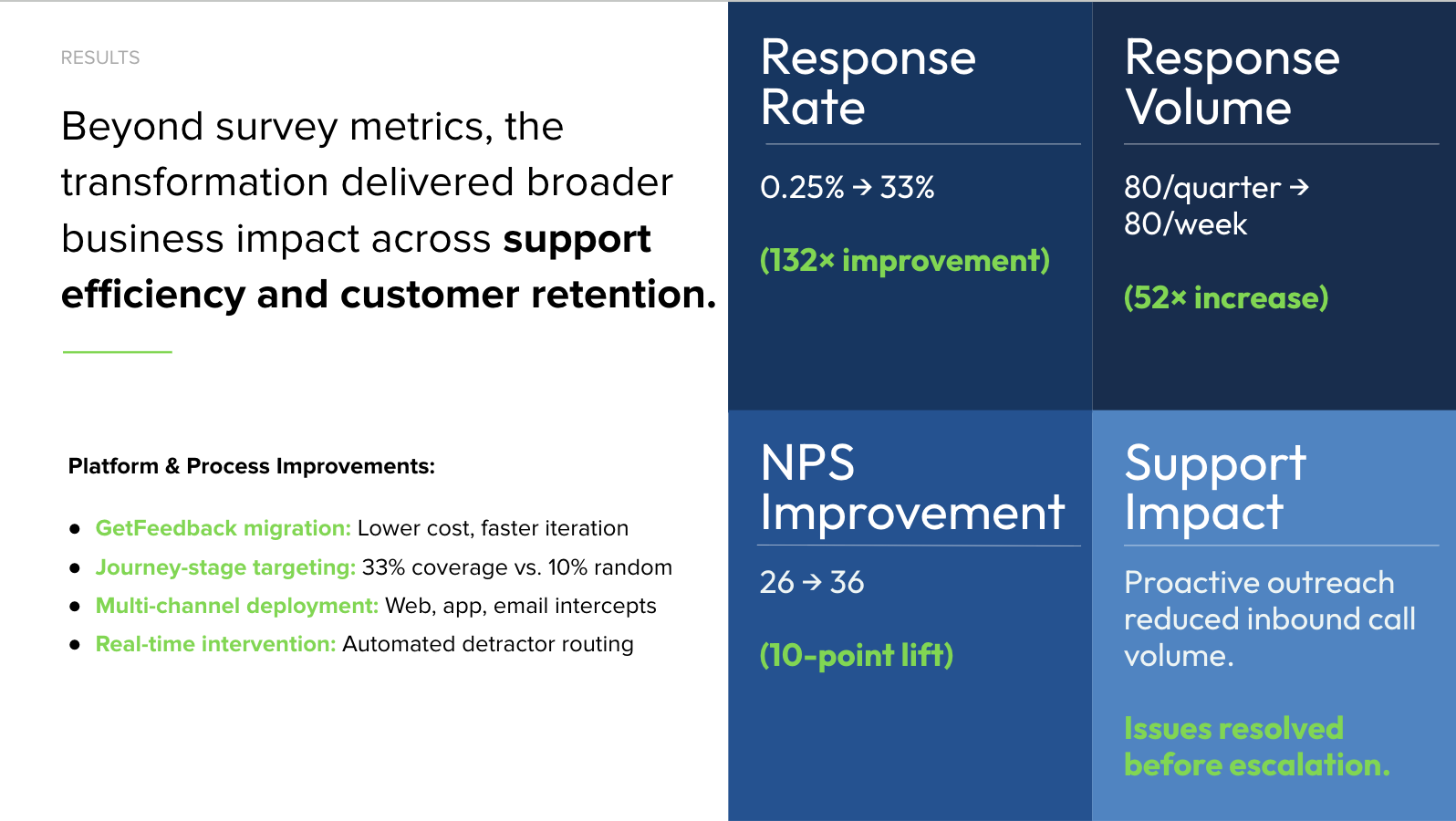
  • 10-point NPS lift (26 → 36) in 6 months
  • 132x response rate improvement (0.25% → 33%)
  • 52x response volume increase (~80/quarter → ~80/week)
  • Real-time intervention system reducing support calls

Overview

In 2019, Ten-X's customer experience surveys were failing the business. Outdated since 2017, they yielded a dismal 0.25% completion rate and just 80 responses per quarter—far too little signal to understand and improve the commercial real estate buyer, seller, and broker journey.

I led a complete transformation of the Voice of Customer program, migrating from Qualtrics to GetFeedback, redesigning survey methodology, and implementing real-time intervention capabilities. This overhaul increased response rates 132x, enabled proactive customer support, and drove a 10-point NPS improvement in six months.

Problem & Business Context

Ten-X's customer feedback system had become a liability rather than an asset. The surveys hadn't been updated since 2017—before significant changes to landing pages and product detail pages—and were producing almost no actionable data.

The Old System's Failures

  • Abysmal response rates: 0.25% completion rate meant we were essentially flying blind
  • Insufficient volume: Only 80 responses per quarter couldn't reveal patterns across buyer segments, property types, or transaction stages
  • Poor targeting: Querying just 10% of visitors randomly, with no user segmentation or journey-stage awareness
  • Survey fatigue: Questions were too many, too long, too wordy—driving abandonment
  • No intervention capability: By the time we saw negative feedback, the customer was already lost

Business Stakes

Without reliable customer feedback, the product team was making decisions based on assumptions rather than data. Support calls were reactive rather than proactive. NPS had plateaued at 26, and we had no systematic way to understand why or how to improve it.

Leadership needed a scalable, automated Voice of Customer system that could surface actionable insights in real time and directly inform product strategy, customer support, and business outcomes.

Users & Audience

Primary Survey Respondents

  • Commercial real estate buyers evaluating properties for investment or business use
  • Property sellers listing commercial assets on the Ten-X marketplace
  • Real estate brokers representing clients in transactions
  • Experience levels: Mix of first-time platform users to seasoned investors with multiple transactions

Survey coverage: Increased from 10% to 33% of site visitors across all journey stages

Internal Stakeholders

  • Product Management: Roadmap prioritization based on user feedback
  • Engineering: Feature development informed by pain points
  • Customer Support: Real-time intervention and issue resolution
  • Executive Leadership: NPS tracking and business performance metrics

My Role

As Lead UX Researcher, I owned the end-to-end transformation of Ten-X's Voice of Customer program:

  • Audited existing survey approach and identified critical gaps in methodology, tooling, and deployment
  • Led platform migration from Qualtrics to GetFeedback, including vendor evaluation, technical integration with Salesforce, and automated deployment configuration
  • Redesigned survey methodology with short, focused questions deployed at key journey touchpoints rather than random sampling
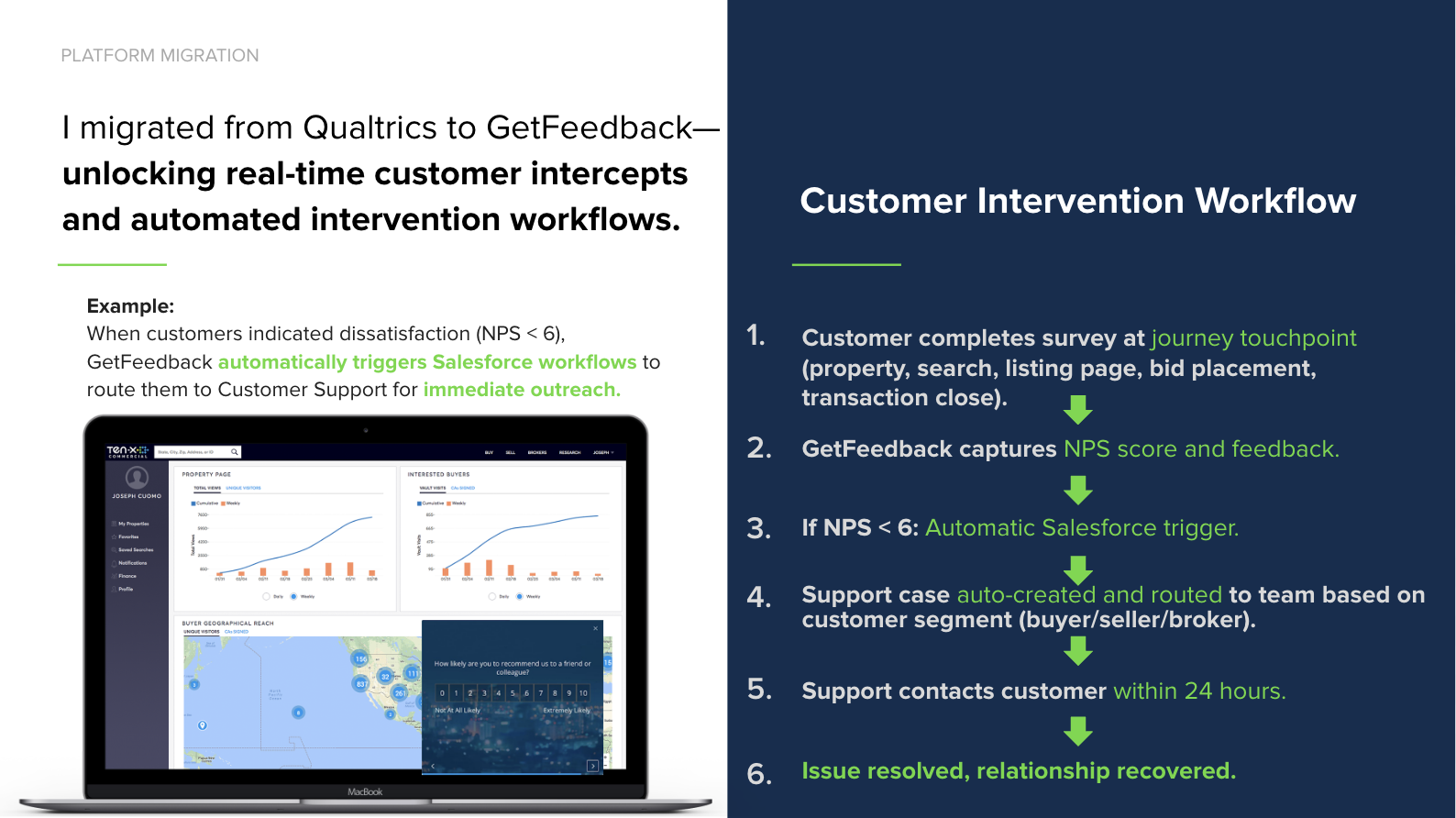
  • Built real-time intervention system to automatically intercept unhappy customers and route them to support for immediate resolution
  • Created reusable survey templates, onboarding materials, and ethical research guidelines for the team
  • Coached teammates through their first research projects and institutionalized best practices across the organization
  • Established automated reporting dashboards for stakeholders to track NPS, completion rates, and actionable insights

Transformation required buy-in from siloed teams who'd never collaborated on research before. I partnered with the Customer Support Director to design the real-time intervention system. She was initially skeptical: "We're already overwhelmed with inbound tickets—this will just add more work." I proposed a 2-week pilot where Support proactively reached out to 10 unhappy customers flagged by the new system. Results: 7 of 10 converted from detractors to promoters after intervention, and Support realized these conversations prevented escalations rather than creating additional burden. This pilot built trust and secured full team adoption across the organization.

Scope & Constraints

  • Timeline: 6-month program transformation from audit through platform migration, survey redesign, and full deployment
  • Budget: Reduced tooling costs by migrating from expensive Qualtrics enterprise license to more cost-effective GetFeedback platform
  • Technical constraints: Required seamless Salesforce integration for customer data and real-time intervention workflows—GetFeedback's native integration was critical
  • Organizational change: Had to build buy-in across Product, Engineering, and Support teams for new workflows and real-time intervention protocols
  • Data continuity: Needed to maintain some consistency with historical metrics while fundamentally changing methodology—balanced by clearly documenting the transition
  • Compliance: Ensured GDPR compliance, informed consent, and secure data storage throughout the migration

Research Process

1

Audit & Gap Analysis

Conducted comprehensive audit of existing survey system: reviewed 2017-era Qualtrics surveys (last updated before major product changes), analyzed completion rates (0.25%) and response volume (80/quarter), identified survey fatigue drivers (too many questions, too wordy, too long), mapped coverage gaps (only 10% of visitors, no journey-stage targeting), and documented lack of real-time intervention capabilities.

Presented findings to leadership with recommendation to completely overhaul the Voice of Customer approach rather than incrementally improve the broken system.

Why This Approach: Rather than optimizing a fundamentally flawed system, I made the case for transformation. The 0.25% completion rate and outdated questions meant any insights were unreliable—we needed to start fresh.
The 0.25% Discovery Moment: The 0.25% response rate wasn't obvious at first glance. When leadership asked me to audit the Voice of Customer program, they said vaguely that "surveys aren't getting much traction." I pulled Qualtrics historical data and did the math: 32,000 invitations sent over 6 months, only 80 completed responses = 0.25% completion rate. I created a single slide showing this calculation and presented it to the Product Director with the line: "We're essentially running research with a statistically meaningless sample size." Her immediate response: "Can you fix this incrementally or do we need to scrap the whole thing and start over?" That conversation greenlit the transformation approach rather than piecemeal improvements.
2

Platform Migration & Technical Integration

Led migration from Qualtrics to GetFeedback based on four critical criteria: (1) Ease of use for rapid survey creation and iteration, (2) Quick launch capabilities without IT bottlenecks, (3) Native Salesforce integration for customer data and automated workflows, (4) Real-time intervention triggers to route unhappy customers to support.

Worked with Engineering to configure automated survey deployment triggers based on user journey stage, customer segment, and previous interaction history.

Why GetFeedback: Qualtrics was powerful but overkill for our needs—slow to build surveys, expensive, and lacked seamless Salesforce integration. GetFeedback was purpose-built for our use case and dramatically reduced cost while improving functionality.
What We Learned: The right tool matters enormously. Moving to a simpler, more integrated platform unblocked the entire team and enabled rapid iteration that was impossible with Qualtrics.
Engineering Partnership: Platform migration required deep Engineering partnership for Salesforce integration. I worked with the lead engineer to map GetFeedback triggers to Salesforce workflows: when a customer submitted low NPS (<6), the system needed to auto-create a Support case and route it to the right team based on customer segment (buyer vs. seller vs. broker). Engineering initially suggested manual routing (simpler to build), but I pushed for automation, showing data that manual routing would require 15+ hours/week of triage labor. We compromised: fully automated routing for the top 3 customer segments (covering 85% of cases), with manual fallback routing for edge cases.
3

Survey Redesign & Journey Mapping

Redesigned survey methodology with focus on reducing fatigue and increasing relevance: (1) Shortened questions—concise, focused, easy to answer, (2) Deployed at key journey touchpoints (property search, listing view, bid placement, transaction close) rather than random sampling, (3) Increased coverage from 10% to 33% of visitors with intelligent targeting based on user background data, (4) Mixed methods—quantitative metrics (NPS, satisfaction ratings) plus qualitative open-ends to capture the "why" behind experiences.

Created modular survey templates that teams could easily customize for specific research questions while maintaining consistency in core metrics.

Why This Approach: Journey-stage targeting meant we were asking relevant questions at the right moment—not interrupting users randomly. Shorter surveys respected user time while still capturing rich insights.
What We Learned: Response rates skyrocketed because surveys felt relevant and quick. Users were willing to share feedback when we asked at the right time with the right questions.
Survey Fatigue Example: The old surveys were exhausting even to read. One question verbatim: "Considering your overall experience with the Ten-X platform including but not limited to the property search functionality, listing detail pages, bidding process, transaction workflows, and customer support touchpoints, how would you rate your overall satisfaction with the user interface design and information architecture?" I showed this to stakeholders alongside a rewrite: "How easy was it to find properties you were interested in?" Response rates on similar questions jumped 40%+ when we made this shift toward conversational, focused language across all survey items.
4

Real-Time Intervention System & Analysis

Built automated real-time intervention system: when customers indicated dissatisfaction (low NPS scores, negative sentiment in open-ends), GetFeedback automatically triggered Salesforce workflows to route them to Customer Support for immediate outreach and issue resolution. This transformed reactive support into proactive relationship management.

Established automated reporting dashboards tracking NPS trends, completion rates, response volume, and thematic analysis of qualitative feedback. Conducted regular thematic coding sessions to identify actionable pain points (financing help, property management connections, education on out-of-state ownership) and opportunity areas for product development.

Why This Worked: Real-time intervention turned negative experiences into recovery opportunities. Support could reach out while the issue was fresh, often converting detractors into promoters through responsive service.
Support Team Training: Real-time intervention only worked if Support knew how to handle proactive escalations effectively. I created a response playbook with templated language for common scenarios (financing confusion, property management referral requests, off-market deal inquiries) and conducted three hands-on training sessions with Support reps. One rep asked: "What if the customer is still angry even after we reach out proactively?" I added a dedicated section on de-escalation techniques and created a Slack channel where Support could ask real-time questions during live interventions. This support infrastructure ensured the system scaled beyond the initial pilot phase.

Key Findings

📈

Survey Fatigue Was Killing Response Rates

The old surveys were too long, too wordy, and asked too many questions—driving 0.25% completion. By shortening surveys and focusing questions on specific journey moments, completion rates jumped to 33% (132x improvement). Users were willing to give feedback when we respected their time.

🎯

Journey-Stage Targeting Increased Relevance

Random sampling meant users were often asked irrelevant questions. By deploying surveys at key touchpoints (search, listing view, bid, close), we captured context-specific feedback. This not only improved response rates but also surfaced actionable insights tied to specific product areas.

💼

Users Needed Financing and Property Management Help

Thematic analysis revealed top pain points: buyers wanted easier access to financing options, sellers needed connections to local property management, and out-of-state investors needed education on remote ownership. These insights directly informed product roadmap priorities.

Promoters Valued Honest, Relevant Information

High-NPS users consistently praised the platform for providing relevant, honest, easy-to-understand property information. This validated the product team's focus on data transparency and guided messaging strategy for marketing.

🔍

Detractors Wanted Personalized Support and Off-Market Deals

Low-NPS users expressed frustration with lack of personalized guidance and limited access to off-market opportunities. Real-time intervention allowed Support to address these concerns immediately, often recovering the relationship before it was lost.

Real-Time Intervention Reduced Support Calls

Proactive outreach to unhappy customers resolved issues before they escalated to formal support tickets. This reduced inbound call volume and improved customer satisfaction—turning potential detractors into advocates through responsive service.

Impact & Outcomes

Business Impact

  • 10-point NPS lift in 6 months (from 26 to 36)—the survey redesign was the primary driver by surfacing actionable pain points and enabling real-time intervention
  • 132x response rate improvement (from 0.25% to 33%)—dramatically increased signal quality for decision-making
  • 52x response volume increase (from ~80 responses per quarter to ~80 per week)—enabled statistically significant insights across customer segments
  • Reduced support call volume through proactive intervention—caught and resolved issues before customers had to reach out
  • Improved customer retention by identifying and addressing pain points in real time

Product Changes Informed by Research

  • Added financing support resources and partner connections based on buyer pain points
  • Built property management referral network for out-of-state investors
  • Created educational content on remote ownership and investment strategies
  • Enhanced personalized recommendation engine based on user preferences and behavior
  • Expanded off-market deal access for high-value customers

Organizational Impact

  • Reduced tooling costs by migrating from expensive Qualtrics to more efficient GetFeedback platform
  • Built reusable survey templates enabling faster research execution across teams
  • Established automated reporting dashboards eliminating manual data aggregation
  • Created onboarding materials and training programs to scale research best practices
  • Instituted ethical guardrails and compliance checklists ensuring GDPR adherence

Deliverables

  • Reusable survey templates with modular question banks for different journey stages and research objectives
  • User journey maps visualizing pain points and opportunities across the customer lifecycle from search to close
  • Automated reporting dashboards tracking NPS trends, completion rates, response volume, and thematic insights
  • Real-time intervention workflows integrated with Salesforce for proactive customer support
  • Onboarding materials and training toolkits enabling teammates to conduct research following best practices
  • Ethical research guidelines and compliance checklists ensuring GDPR adherence and participant well-being

Reflections & What I'd Do Differently

What Worked Well

  • Transformation over optimization: Rather than trying to fix a broken system incrementally, making the case for complete overhaul delivered far greater impact
  • Right-sized tooling: GetFeedback was simpler, cheaper, and better integrated than Qualtrics—proving that more expensive doesn't always mean better
  • Journey-stage targeting: Asking relevant questions at the right moment dramatically improved response rates and insight quality
  • Real-time intervention: Proactive outreach transformed customer relationships and demonstrated immediate ROI from research investment

What I'd Do Differently

  • Earlier qualitative deep-dives: Complement surveys with in-depth interviews to uncover richer context around pain points and motivations
  • Automated panel management: Build more sophisticated segmentation and incentive distribution systems to further optimize response quality
  • Longitudinal tracking: Follow individual customers over time to understand how experiences evolve throughout their lifecycle
  • Expanded training programs: Invest more in empowering cross-functional teams to leverage research insights and conduct their own studies

Skills Demonstrated in This Project

Voice of Customer Program Design
Survey Methodology & Redesign
Platform Migration & Vendor Evaluation
Salesforce Integration
Real-Time Intervention Systems
Journey Mapping
Mixed-Methods Research (Quant + Qual)
Thematic Analysis
NPS Tracking & Optimization
Automated Reporting Dashboards
Team Training & Onboarding
GDPR Compliance & Research Ethics